Nine Palaces in Qimen Dunjia: Positions and Basic Symbolism
Learn the Nine Palaces in Qimen Dunjia, including their trigrams, elements, directions, and basic meanings in a Qimen chart.
In Qimen Dunjia, the Nine Palaces form the basic grid that holds the symbols of a Qimen chart. They are Kan Palace, Kun Palace, Zhen Palace, Xun Palace, the Center Palace, Qian Palace, Dui Palace, Gen Palace, and Li Palace. The Nine Palaces come from the Later Heaven Bagua and appear as a nine-grid layout in a Qimen Dunjia chart.
The Eight Doors, Nine Stars, Eight Spirits, and Heavenly Stems are all placed inside these palaces. When reading a chart, the palace gives context to the symbols inside it.
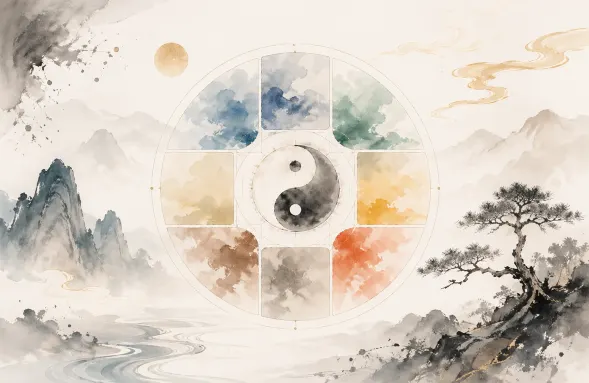
What Are the Nine Palaces in Qimen Dunjia?
The Nine Palaces are the nine positions in a Qimen chart. Each palace has a name, trigram, direction, element, and set of meanings.
| Palace | Trigram | Later Heaven Direction | Element | Common Meanings |
|---|---|---|---|---|
| Kan Palace | Kan | North | Water | Change, hardship, movement, effort |
| Kun Palace | Kun | Southwest | Earth | Support, tolerance, complexity, service |
| Zhen Palace | Zhen | East | Wood | Movement, action, sudden events, growth |
| Xun Palace | Xun | Southeast | Wood | Wind, spreading, hesitation, penetration |
| Center Palace | No fixed trigram | Center | Earth | Center, transition, palace assignment |
| Qian Palace | Qian | Northwest | Metal | Authority, leadership, decision, height |
| Dui Palace | Dui | West | Metal | Speech, joy, harvest, defect |
| Gen Palace | Gen | Northeast | Earth | Stillness, blockage, mountain, waiting |
| Li Palace | Li | South | Fire | Brightness, fame, beauty, appearance |
In Qimen Dunjia reading, the palace often shows the environment, direction, and condition of the matter. A symbol carries the nature of the palace where it is placed. For beginners, a simple way to study this is to observe where the Hour Stem falls, then read the palace meaning in relation to the question. To see the Nine Palaces, Eight Doors, Nine Stars, and Eight Spirits in a chart, you can use the AskQimen online Qimen Dunjia chart tool and compare the chart with the meanings below.
Kan Palace: Water, Movement, Hardship, and Change
Kan Palace corresponds to the Kan trigram. Its element is Water, and its Later Heaven direction is north. Water is fluid, adaptive, and constantly moving. Kan Palace is often linked with change, hardship, danger, wandering, labor, and effort.
In people-related symbolism, Kan may represent the middle son, wanderers, fugitives, laborers, sailors, drivers, fishery workers, and people in mobile occupations. In the body, it relates to the kidneys, bladder, urinary system, reproductive system, blood, endocrine system, and bone marrow. In illness, it may indicate kidney issues, urinary problems, cold conditions, fluid retention, or swelling.
When asking about a matter, Kan often suggests a difficult process, movement, travel, or change. For work, it may show labor, mobility, travel, or job instability. For health, the reading should focus on the body systems related to Water.
Kun Palace: Earth, Support, Tolerance, and Complexity
Kun Palace corresponds to the Kun trigram. Its element is Earth, and its Later Heaven direction is southwest. Kun represents the earth, which supports and nourishes all things. It is linked with tolerance, patience, support, and heaviness. It may also suggest complexity, too many matters, compromise, or lack of personal direction.
In people-related symbolism, Kun may represent the mother, women, crowds, farmers, real estate workers, agriculture workers, assistants, and female leaders. In the body, it relates to the abdomen, right shoulder, muscles, female reproductive organs, digestive organs, spleen, and navel. In illness, it may point to stomach problems, digestive issues, poor appetite, swelling, or chronic conditions.
For work, Kun may indicate service work, land-related work, agriculture, real estate, or a job with many mixed tasks. For health, it often points toward the abdomen, spleen, stomach, digestion, or female reproductive system.
Zhen Palace: Thunder, Action, Sudden Events, and Growth
Zhen Palace corresponds to the Zhen trigram. Its element is Wood, and its Later Heaven direction is east. Zhen is Thunder. It also relates to spring growth. It represents movement, rising force, impulse, surprise, sudden events, and outward growth.
In people-related symbolism, Zhen may represent the eldest son, drivers, athletes, pilots, musicians, singers, people in conflict, police officers, and judges. In the body, it relates to the feet, liver, tongue, throat, left arm, and left hand. Its traits include quick action, strong sound, rapid change, impatience, and self-respect.
For work, Zhen often relates to transportation, movement, law enforcement, sports, sound, and performance. For fortune, it may show rapid movement or sudden change. For health, it may relate to the feet, liver, throat, shock, nervous tension, or sprains.
Xun Palace: Wind, Spreading, Penetration, and Hesitation
Xun Palace corresponds to the Xun trigram. Its element is Wood, and its Later Heaven direction is southeast. Xun is Wind. Wind is gentle, shifting, penetrating, and able to spread. Xun Palace is linked with obedience, humility, uncertainty, lack of firm direction, freedom, and communication.
In people-related symbolism, Xun may represent the eldest daughter, teachers, Taoist practitioners, wanderers, hesitant people, refined people, journalists, and marketing workers. In the body, it relates to the thighs, liver, gallbladder, trachea, nerves, and left shoulder. In illness, it may indicate colds, wind-related illness, respiratory disease, or contagious disease.
For work, Xun often relates to education, communication, media, marketing, logistics, lines, pipes, wood, flowers, and plants. For progress, it may show hesitation or repeated changes. For health, it often points to breathing, the trachea, wind conditions, or transmission.
Center Palace: Center, Transition, and Palace Assignment
The Center Palace sits in the middle of the Nine Palaces. It does not directly correspond to one of the eight trigrams, so its meaning is more limited than the other palaces.
In Qimen charting, the Center Palace often involves palace assignment. Since the center does not have a direct trigram image, the reading depends on the charting method and where the center symbols are assigned.
Qian Palace: Heaven, Authority, Leadership, and Decision
Qian Palace corresponds to the Qian trigram. Its element is Metal, and its Later Heaven direction is northwest. Qian is Heaven. It represents strength, order, authority, leadership, decision-making, height, breadth, beauty, refinement, and active force.
In people-related symbolism, Qian may represent the father, ruler, boss, leader, elder, senior person, expert, respected person, or official. In the body, it relates to the head, face, bones, lungs, and male reproductive organs. Its traits include strength, dignity, firmness, honor, and authority.
For work, Qian may indicate leadership, management, official positions, senior roles, or decision-making power. For fortune, it may show upward movement, expansion, or higher status. For health, it may point to the head, face, bones, or lungs.
Dui Palace: Lake, Speech, Joy, and Harvest
Dui Palace corresponds to the Dui trigram. Its element is Metal, and its Later Heaven direction is west. Dui is Lake and also represents the mouth. It is linked with speech, joy, communication, absorption, harvest, and visible defects.
In people-related symbolism, Dui may represent young girls, singers, operators, teachers, presenters, translators, dentists, cooks, and shamans. In the body, it relates to the mouth, tongue, teeth, throat, lungs, and trachea. In illness, it may point to oral disease, dental problems, tongue issues, throat disease, asthma, or coughing.
For work, Dui often relates to speaking, sales, teaching, translation, food, entertainment, and public communication. It may also bring disputes caused by words. For fortune, Dui can show joy, harvest, and social contact. For relationships, it may indicate a lover or third party when supported by other chart signs.
Gen Palace: Mountain, Stillness, Blockage, and Waiting
Gen Palace corresponds to the Gen trigram. Its element is Earth, and its Later Heaven direction is northeast. Gen is Mountain. It represents blockage, stillness, difficulty, and waiting. Its trigram image also suggests a hard exterior and hollow interior.
In people-related symbolism, Gen may represent the youngest son, boys, mountain people, construction workers, miners, real estate workers, merchants, prisoners, conservative people, lonely people, and mountain practitioners. In the body, it relates to the nose, back, fingers, joints, left leg, toes, breasts, spleen, and stomach. In illness, it may point to muscle and bone pain, spleen and stomach problems, indigestion, stones, lumps, numbness, or skin bumps.
For work, Gen often shows slow progress, blockage, waiting, and hard-to-solve problems. It may also point to construction, mining, real estate, or metaphysical work. For fortune, it often suggests a pause or slow movement. For health, it may point to the nose, back, fingers, joints, spleen, or stomach.
Li Palace: Fire, Brightness, Fame, and Appearance
Li Palace corresponds to the Li trigram. Its element is Fire, and its Later Heaven direction is south. Li is Fire and the sun. It represents brightness, visibility, beauty, outward expression, fame, color, and display. It may also suggest vanity, exaggeration, or a bright surface with weaker substance inside.
In people-related symbolism, Li may represent the middle daughter, scholars, artists, beauty industry workers, actors, writers, electronics workers, and publicity workers. In the body, it relates to the heart, eyes, small intestine, blood, head, and face. In illness, it may point to heart disease, eye problems, nearsightedness, headache, hallucination, burns, heat illness, or facial disease.
For work, Li often relates to art, publicity, advertising, electronics, video, beauty, education, books, and documents. For fortune, it may show visibility, fame, or outward attention. For health, it may point to the heart, cardiovascular system, eyes, headache, or heat conditions.
The Role of the Nine Palaces in Qimen Dunjia Reading
The Nine Palaces help identify the environment, direction, nature, and condition of a matter. In a basic reading, you can observe where the Hour Stem falls, then connect the question with the meaning of that palace.
- For work, read the palace through career, role, and workplace conditions.
- For illness, read the palace through body parts and disease symbolism.
- For fortune, read the palace through the state of development.
- For relationships, read the palace through people and emotional symbolism.
- For wealth, read the palace through industry, environment, gain, and blockage.
The Nine Palaces are only one part of Qimen Dunjia reading. A full reading also needs the Eight Doors, Nine Stars, Eight Spirits, Heavenly Stems, useful gods, and chart patterns. Reading the palace alone can give a starting direction, but it should not replace a complete chart analysis.
Summary
The Nine Palaces are the basic grid of a Qimen Dunjia chart. Kan, Kun, Zhen, Xun, Center, Qian, Dui, Gen, and Li each carry their own trigram, element, direction, and symbolic meanings. To study them, begin with the trigram image, then extend it to people, body parts, illness, career, places, objects, and the condition of a matter.
Once you understand the Nine Palaces, it becomes easier to read the Eight Doors, Nine Stars, Eight Spirits, and Heavenly Stems inside a Qimen chart. For beginners, the Nine Palaces are one of the main foundations for learning Qimen charting and interpretation.
Generate a Qimen Chart Online
Choose a place and time, view the True Solar Time corrected chart, and explore its doors, stars, palaces, and stems.
Keep Reading
Explore more related Qimen basics articles.
Eight Gates in Qimen Dunjia: Meanings and Uses
Learn the Eight Gates in Qimen Dunjia, including their meanings, elements, palace positions, fortune tendencies, and basic uses.
Qimen Dunjia Charting Steps Explained
Learn the basic Qimen Dunjia charting steps, from Ju selection to stems, spirits, stars, doors, void, horse, and center placement.
Nine Stars in Qimen Dunjia: Meanings and Practical Reading
Learn what the Nine Stars mean in Qimen Dunjia, including their elements, original palaces, strength, and role in chart reading.
Qimen Dunjia: Origins, Schools, and Uses
Qimen Dunjia is a traditional Chinese divination system for questions, timing, direction, and decision-making. Learn its origins, schools, and uses.
Explore More Qimen
Generate a chart online, then continue with term explanations and topic guides.