Nine Stars in Qimen Dunjia: Meanings and Practical Reading
Learn what the Nine Stars mean in Qimen Dunjia, including their elements, original palaces, strength, and role in chart reading.
In Qimen Dunjia, the chart is often understood through Heaven, Earth, and Human factors. The Nine Palaces belong to the Earth plate, the Eight Doors belong to the Human plate, and the Nine Stars belong to the Heaven plate.
The Nine Stars mainly represent timing, larger trends, outer conditions, natural temperament, personal disposition, and factors that are difficult for a person to change directly.
The Nine Stars in Qimen Dunjia are Tian Peng, Tian Ren, Tian Chong, Tian Fu, Tian Ying, Tian Rui, Tian Zhu, Tian Xin, and Tian Qin. They correspond to the Nine Stars of the Northern Dipper and move through the Qimen chart together with the palaces, doors, stems, and other symbols.
If you want to cast a chart and see where the Nine Stars appear in relation to your question, you can use the AskQimen online Qimen chart tool. After entering the time and your question, you can compare the chart with the meanings below.
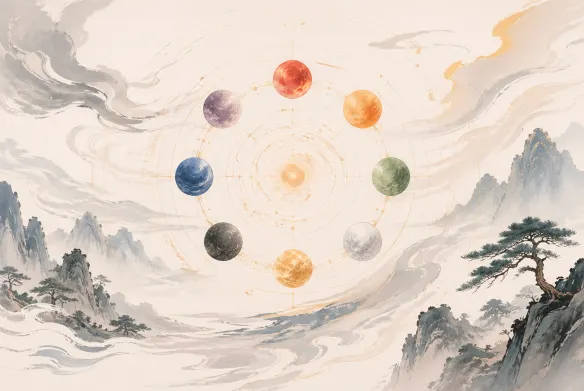
What Do the Nine Stars Represent in Qimen?
The Nine Stars are placed on the Heaven plate. They are mainly used to read timing, external conditions, larger trends, personal temperament, career tendency, health condition, and the general direction of a matter.
A star should not be judged only by its name or by a simple lucky-or-unlucky label. Each star has its own nature, strength, palace, element, and symbolic range. The same star can show favorable meanings when strong and unfavorable meanings when weak. A reading should also consider the question, palace, door, stem, and other chart signs.
Overview of the Nine Stars
| Star | Element | Original Palace | Yin / Yang | Nature | Main Meanings |
|---|---|---|---|---|---|
| Tian Peng | Water | Kan Palace | Yang | Inauspicious | Risk, secrecy, theft, loss, boldness, water-related matters |
| Tian Ren | Earth | Gen Palace | Yang | Auspicious | Responsibility, endurance, land, property, farming, accumulation |
| Tian Chong | Wood | Zhen Palace | Yang | Auspicious | Action, movement, competition, expansion, thunder, initiative |
| Tian Fu | Wood | Xun Palace | Yang | Auspicious | Education, culture, writing, support, elegance, communication |
| Tian Ying | Fire | Li Palace | Yin | Mildly inauspicious | Light, fame, appearance, documents, fire, impatience, bloodshed |
| Tian Rui | Earth | Kun Palace | Yin | Inauspicious | Illness, problems, learning, teachers, land, accumulation |
| Tian Zhu | Metal | Dui Palace | Yin | Inauspicious | Speech, disputes, damage, fear, sound, reform |
| Tian Xin | Metal | Qian Palace | Yin | Auspicious | Medicine, leadership, planning, management, valuable items, metaphysics |
| Tian Qin | Earth | Central Palace | Yang | Auspicious | Balance, authority, central control, broad judgment, often read with Tian Rui |
Tian Peng: Risk, Secrecy, and Water Imagery
Tian Peng corresponds to the Kan Palace and belongs to Water. Kan carries images of coldness, darkness, depth, and hidden activity. For this reason, Tian Peng is often connected with secrecy, theft, financial loss, risk, desire, alcohol, and bold action.
When Tian Peng is strong, it can describe a bold person with courage and appetite for risk. It may also point to speculative business or adventurous fields. When weak, it may show greed, loss, hidden profit, petty theft, or questionable conduct.
For matters such as marriage, construction, moving home, or opening a business, Tian Peng usually calls for caution. Helpful signs in the same chart can reduce the negative effect, but the risk meaning should still be kept in mind.
Tian Ren: Responsibility, Land, and Endurance
Tian Ren corresponds to the Gen Palace and belongs to Earth. It is an auspicious star. Gen carries images of mountains, stillness, support, and accumulation. Tian Ren often represents responsibility, diligence, honesty, fields, real estate, farming, mining, and long-term effort.
When Tian Ren is strong, it may describe a reliable, patient, and responsible person. In career readings, it can point to land, property, agriculture, planting, mining, construction, or practical work. When weak, it may show stubbornness, slowness, hard work with limited return, or a lack of flexibility.
Although Tian Ren is auspicious, its benefit is usually steady and practical. It does not always suggest sudden wealth.
Tian Chong: Action, Expansion, and Thunder
Tian Chong corresponds to the Zhen Palace and belongs to Wood. Zhen is associated with thunder, movement, sound, action, and expansion. Tian Chong represents initiative, speed, competition, action, and outward movement.
When Tian Chong is strong, it supports active effort, market expansion, competition, and quick execution. It can also describe a direct, energetic, and action-oriented person. When weak, it may show rash behavior, impulsiveness, poor planning, or acting too soon.
In career readings, Tian Chong favors promotion, expansion, competition, and active projects. For matters that require calmness, such as marriage or long travel, its combative quality should be read with care.
Tian Fu: Culture, Education, and Support
Tian Fu corresponds to the Xun Palace and belongs to Wood. It is linked with literary talent, education, culture, documents, and support.
When Tian Fu is strong, it favors study, exams, teaching, writing, planning, publishing, communication, and cultural work. It may also describe a refined, educated, and supportive person. When weak, it may show hesitation, lack of direction, stiffness in thinking, or overreliance on others.
For career direction, Tian Fu is suitable for education, culture, consulting, content creation, publishing, planning, assistant roles, and advisory work.
Tian Ying: Light, Fame, and Fire Imagery
Tian Ying corresponds to the Li Palace and belongs to Fire. Li carries images of light, beauty, documents, display, electricity, fire, appearance, and visibility. Tian Ying can represent fame, appearance, manners, art, electronics, lighting, media, certificates, books, and images.
When Tian Ying is strong, it may describe a person with reputation, style, manners, and public visibility. It can also support writing, planning, media, film, beauty, electronics, and lighting-related work. When weak, it may show impatience, vanity, temper, weak inner support, or a focus on appearance over substance.
Tian Ying is also linked with bloodshed and fire risk. For travel, relocation, money matters, or construction, Tian Ying suggests caution.
Tian Rui: Illness, Problems, and Learning
Tian Rui corresponds to the Kun Palace and belongs to Earth. Because it is closely related to the imagery of the Death Door in Kun, it is often called the illness star. It can represent illness, mistakes, problems, flaws, and weakness.
At the same time, Kun Earth also carries meanings of tolerance, nurturing, accumulation, and teaching. Tian Rui can also represent study, teachers, doctors, students, women, land, crops, books, and schools.
In health readings, Tian Rui often points to a physical issue and should be read with other signs to judge the body area and nature of the condition. For study, training, and accumulation, it can be useful. When strong, Tian Rui supports learning, medical fields, land-related work, and quiet preparation. When weak, it may show poor health, stubbornness, slowness, or mistakes.
Tian Zhu: Speech, Damage, and Reform
Tian Zhu corresponds to the Dui Palace and belongs to Metal. Dui is linked with the mouth, speech, sound, and the sharpness of autumn metal. Tian Zhu often represents disputes, arguments, damage, fear, unusual events, injury, sound, musical instruments, metal objects, and upright forms.
When Tian Zhu is strong, it can describe eloquence, debate, reform, and the ability to handle old problems. It may also relate to law, military, police, discipline, teaching, legal work, singers, performers, and professions that rely on speech or rules. When weak, it may show conflict, financial loss, damaged plans, lawsuits, injury, or verbal trouble.
In career readings, Tian Zhu can be useful for reform, correction, and restructuring. For travel, business, or money matters, it calls for caution.
Tian Xin: Medicine, Leadership, and Strategy
Tian Xin corresponds to the Qian Palace and belongs to Metal. It is an auspicious star. Qian carries images of heaven, father, leadership, authority, management, and command. Tian Xin often represents leaders, management, strategy, medicine, doctors, metaphysics, and valuable items.
When Tian Xin is strong, it may describe a capable, intelligent, strategic, and managerial person. It can also support medicine, management, consulting, planning, finance, valuable goods, and metaphysical study. When weak, it may show control, pressure, calculation, or excessive authority.
For medicine, seeking help from seniors or authorities, management issues, and career planning, Tian Xin is usually favorable.
Tian Qin: The Central Star, Often Read with Tian Rui
Tian Qin is placed in the Central Palace and belongs to Earth. In many Qimen chart systems, the Central Palace is assigned to Kun, so Tian Qin often appears together with Tian Rui. For this reason, Tian Rui is often referenced when reading Tian Qin.
Tian Qin carries meanings of centrality, balance, authority, and integration. It does not have as direct a directional image as the other stars. When paired with auspicious doors, favorable formations, and strength, it can support balance and stability. When paired with unfavorable signs, Tian Rui’s meanings of illness, problems, and delay should be considered.
How Star Strength Is Judged
The Nine Stars can be judged through five states: prosperous, supportive, resting, trapped, and wasted. A common method compares the element of the star with the element of the month or palace.
| Element Relationship | State |
|---|---|
| What I generate | Prosperous |
| Same element as me | Supportive |
| What I control | Resting |
| What controls me | Trapped |
| What generates me | Wasted |
For example, Tian Peng belongs to Water. Water generates Wood, so Tian Peng can be prosperous in a Wood month or Wood palace. Water meeting Water is supportive. Water controlling Fire is resting. Earth controlling Water is trapped. Metal generating Water is wasted.
Star strength is often more useful than a simple lucky-or-unlucky label. An auspicious star becomes weaker when it is weak, while an inauspicious star may show a milder effect when strong. In actual reading, the star meaning, strength, question, palace, door, and stem should be read together.
What to Keep in Mind When Learning the Nine Stars
The Nine Stars should not be read in isolation. Tian Peng does not always mean financial loss, and Tian Xin does not make every matter favorable. Each star has an original palace, element, Yin or Yang nature, general auspiciousness, and strength. Its meaning also changes according to the question.
When learning the Nine Stars, remember three points: they belong to the Heaven plate; each star should be understood through its original palace; and strength affects which side of the star is more likely to appear.
When strong, a star often shows more favorable meanings. When weak, it often shows more unfavorable meanings. Still, the reading should remain within the symbolic range of that star.
Summary
The Nine Stars are important Heaven plate symbols in Qimen Dunjia. They are Tian Peng, Tian Ren, Tian Chong, Tian Fu, Tian Ying, Tian Rui, Tian Zhu, Tian Xin, and Tian Qin. They correspond to the Nine Stars of the Northern Dipper and also connect with different elements, palaces, Yin-Yang qualities, and auspicious or inauspicious tendencies.
The Nine Stars can be used to read external conditions, personality, career direction, health, wealth matters, travel, and the development of a situation. To learn them well, start with each star’s original palace and symbolic meanings, then combine them with strength and the question being asked. This allows the Nine Stars to play their proper role in a Qimen chart reading.
Generate a Qimen Chart Online
Choose a place and time, view the True Solar Time corrected chart, and explore its doors, stars, palaces, and stems.
Keep Reading
Explore more related Qimen basics articles.
Eight Deities in Qimen Dunjia
Learn the Eight Deities in Qimen Dunjia, including Chief, Teng Snake, Great Yin, Six Harmony, White Tiger, Black Tortoise, Nine Earth, and Nine Heaven.
Eight Gates in Qimen Dunjia: Meanings and Uses
Learn the Eight Gates in Qimen Dunjia, including their meanings, elements, palace positions, fortune tendencies, and basic uses.
Heavenly Stems in Qimen Dunjia: Three Wonders and Six Instruments
Learn the Heavenly Stems in Qimen Dunjia, including the Ten Stems, Three Wonders, Six Instruments, and key chart meanings.
Nine Palaces in Qimen Dunjia: Positions and Basic Symbolism
Learn the Nine Palaces in Qimen Dunjia, including their trigrams, elements, directions, and basic meanings in a Qimen chart.
Explore More Qimen
Generate a chart online, then continue with term explanations and topic guides.